






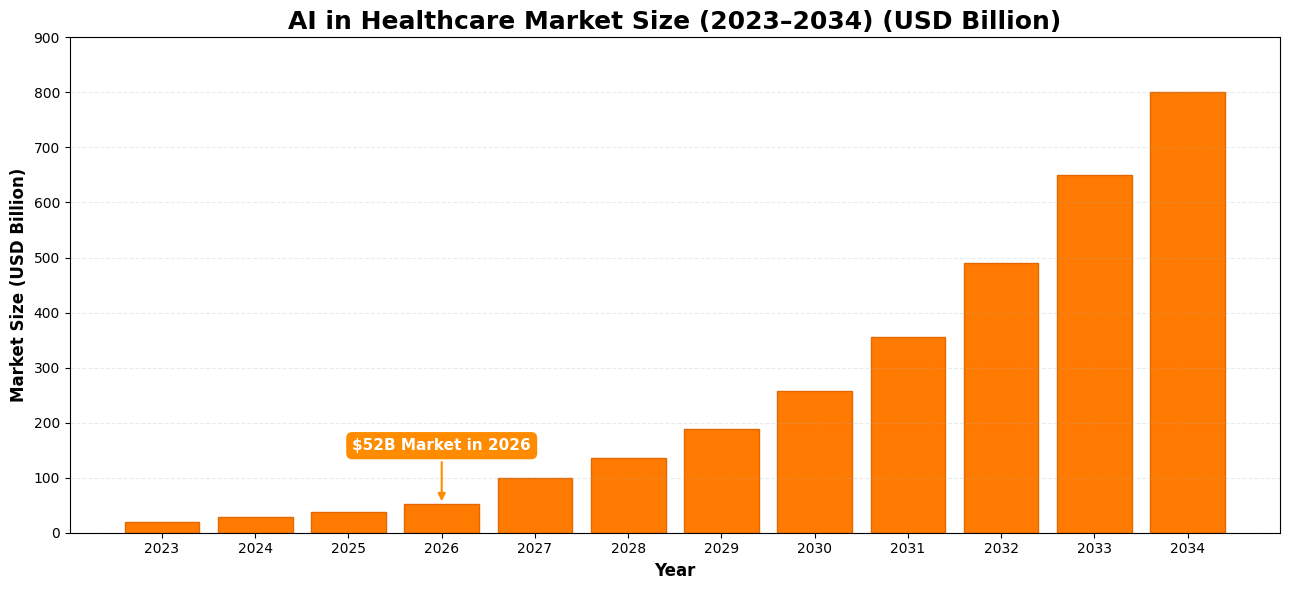
The global AI in healthcare market is projected to reach $67.4 billion by 2026, growing at a CAGR of 41.7% from 2021, driven by hospitals, telemedicine platforms, and diagnostic systems adopting AI solutions. Healthcare providers are increasingly investing in AI-powered platforms for clinical decision support, medical imaging, predictive analytics, and workflow automation, which directly affects implementation costs.
On average, AI healthcare implementation costs can range between $50,000 to $500,000 for small to mid-scale projects, while enterprise-level deployments can exceed $1 million, depending on data complexity, integration with EHR/EMR systems, telemedicine solutions, and compliance requirements like HIPAA.
Key cost drivers include:
- Data acquisition and cleaning: 25–30% of total project cost
- AI model development and training: 20–25%
- Software integration and customization: 30–35%
- Compliance and security: 10–15%
Market insight: Hospitals adopting AI report 15–30% improvement in operational efficiency and 25% reduction in administrative costs within the first year. Companies like Kuchoriya TechSoft help healthcare providers estimate AI implementation costs accurately and choose scalable, ROI-driven AI solutions, ensuring investment translates into measurable efficiency and patient care improvements.
Cost of Implementing AI in Healthcare
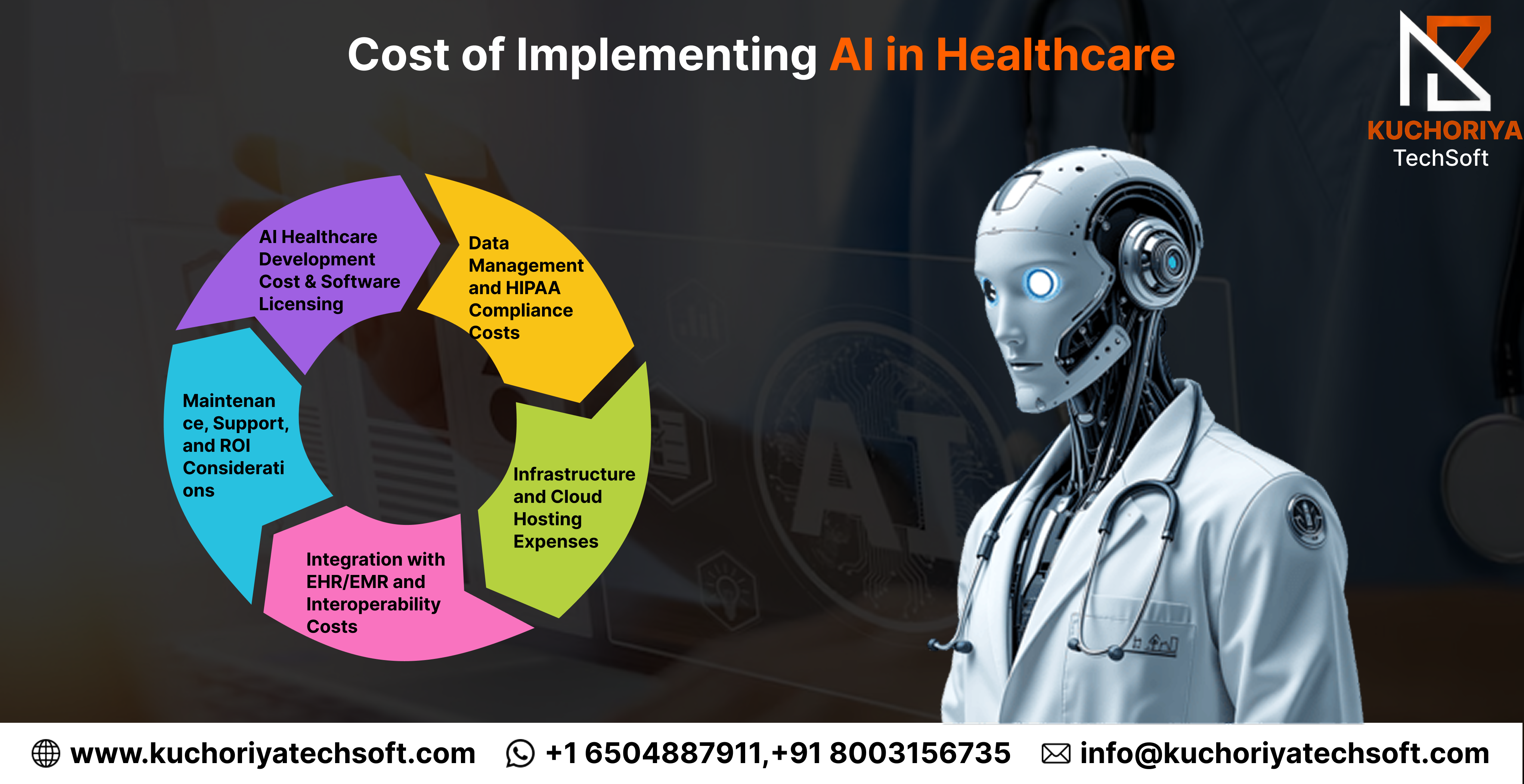
Implementing AI in healthcare can transform patient care and hospital operations, but understanding the AI healthcare cost is crucial for budgeting and planning. Costs vary depending on software, infrastructure, and compliance requirements.
1. AI Healthcare Development Cost & Software Licensing
Developing AI solutions for hospitals involves a significant AI healthcare development cost. This includes healthcare software cost, medical software development pricing, and hospital software development cost for custom solutions or licensed platforms.
2. Data Management and HIPAA Compliance Costs
High-quality medical data is essential for AI models. Expenses include AI healthcare implementation cost, HIPAA-compliant software cost, HIPAA compliance implementation cost, healthcare software compliance cost, and patient data management system cost to secure sensitive information.
3. Infrastructure and Cloud Hosting Expenses
Running AI platforms requires robust hardware and cloud services. Consider AI healthcare infrastructure cost, AI healthcare cloud hosting cost, digital healthcare platform cost, and AI healthcare scalability cost for seamless performance across hospital networks.
4. Integration with EHR/EMR and Interoperability Costs
Integrating AI with existing EHR software development cost, EMR system pricing, AI EHR integration cost, healthcare interoperability cost, clinical data integration pricing, and healthcare API integration cost ensures smooth workflow and data accuracy.
5. Maintenance, Support, and ROI Considerations
AI systems need continuous updates and support. Include AI healthcare maintenance and support cost, AI healthcare total cost of ownership, and AI healthcare ROI to evaluate long-term benefits versus initial investment.
Must Read: AI Fitness App Development in 2026: Cost Breakdown, Features & Market Trends
AI Healthcare Pricing Models
Choosing the right AI healthcare pricing model is crucial for hospitals and healthcare providers to balance cost and value. Pricing depends on software type, deployment, and level of customization.
1. Subscription-Based Pricing
Many AI healthcare solutions use a subscription model, charging hospitals a recurring fee. This covers AI healthcare software cost, digital healthcare platform cost, and telemedicine software cost, making budgeting predictable.
2. One-Time Licensing Fees
Some providers offer AI healthcare platform development pricing with a one-time license. This includes medical software development pricing, hospital software development cost, and sometimes AI healthcare implementation cost, suitable for organizations preferring upfront investment.
3. Pay-Per-Use or Transaction-Based Models
In telemedicine and remote monitoring, virtual care platform pricing or AI telemedicine solution cost may follow a pay-per-use model. Hospitals pay based on patient interactions or API calls, reducing initial expenditure.
4. Custom Enterprise Solutions
For large-scale hospitals, enterprise healthcare solutions and AI healthcare cloud hosting are calculated individually. Custom solutions consider AI healthcare infrastructure cost, EHR/EMR integration pricing, and healthcare interoperability cost for seamless operations.
5. Hybrid Models
Hybrid pricing combines subscription, licensing, and usage-based fees. This approach helps manage AI healthcare total cost of ownership while allowing scalability, including remote patient monitoring software cost and AI healthcare maintenance and support cost.
AI Healthcare Development Cost Breakdown
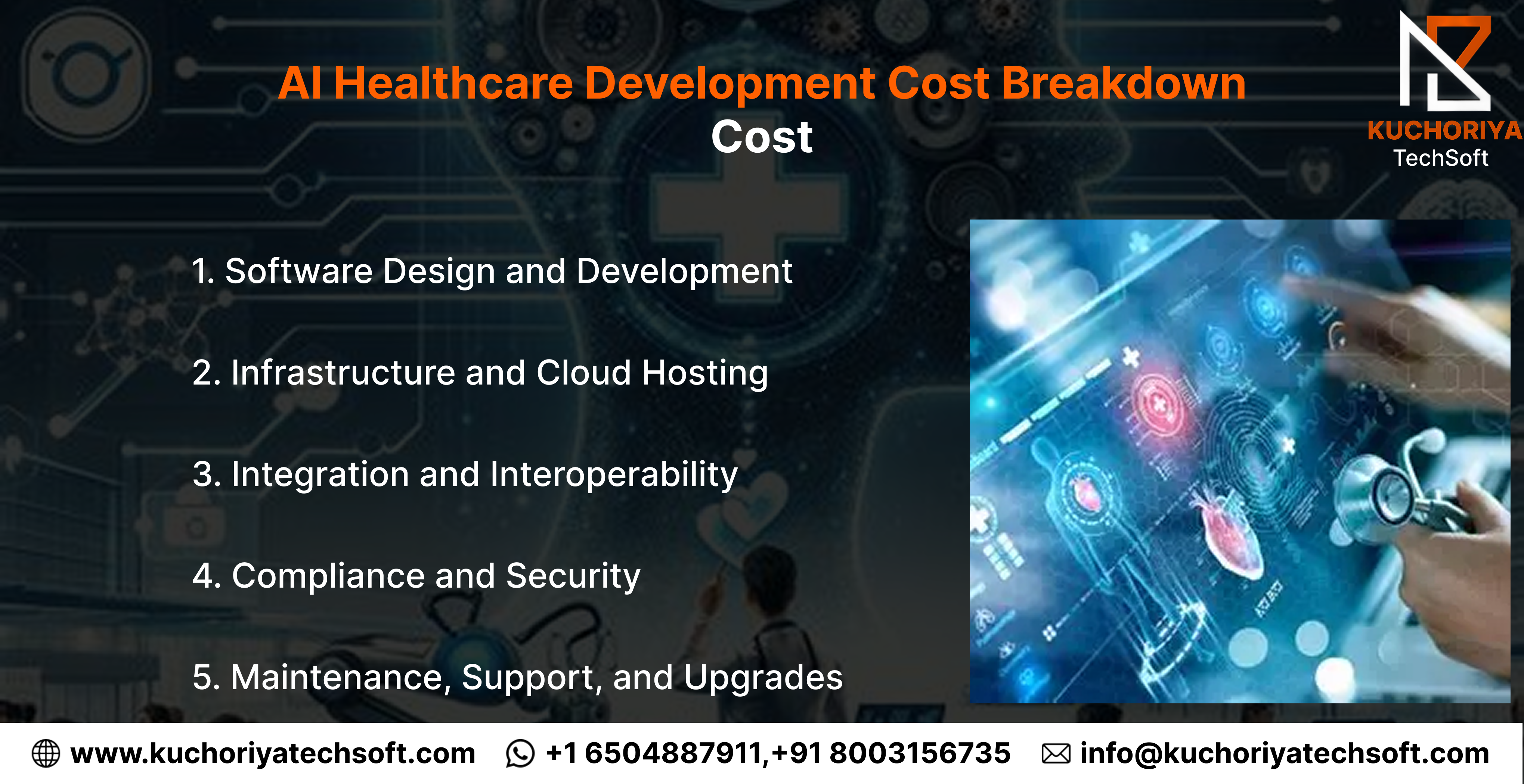
Developing AI solutions for healthcare requires careful budgeting, as multiple factors contribute to the AI healthcare development cost. Understanding each component helps hospitals and startups plan investments effectively.
1. Software Design and Development
Creating AI healthcare software involves custom AI solution pricing, healthcare software costs, medical software development pricing, and AI SaaS platform development costs. Complexity and customization increase the total expense.
2. Infrastructure and Cloud Hosting
Running AI solutions requires robust hardware and cloud resources. The costs of AI healthcare infrastructure, AI healthcare cloud hosting, and digital healthcare platforms are key components for scalability and performance.
3. Integration and Interoperability
Connecting AI tools with existing systems adds costs. This includes EHR/EMR integration pricing, healthcare API integration cost, healthcare interoperability cost, and clinical data integration pricing for seamless workflows.
4. Compliance and Security
Ensuring HIPAA-compliant software cost, healthcare software compliance cost, AI blockchain healthcare cost, and secure medical records blockchain cost is crucial to protect patient data and meet legal requirements.
5. Maintenance, Support, and Upgrades
AI systems need continuous updates. AI healthcare maintenance and support costs, AI healthcare total cost of ownership, and ongoing optimization are vital to maintain accuracy and efficiency.
AI Healthcare Development Cost Breakdown Table
Telemedicine, EHR, EMR & HIPAA Compliance Cost
The cost of digital healthcare systems depends on telemedicine platforms, electronic records, and strict compliance requirements. Proper planning helps control healthcare digital transformation cost while ensuring patient safety and scalability.
1. Telemedicine Platform Development
Building virtual care solutions includes telemedicine platform development pricing, AI telemedicine solution cost, and virtual care platform pricing. Costs vary based on video consultations, chatbots, and AI diagnostics.
2. Remote Patient Monitoring Systems
Connected care solutions involve remote patient monitoring software cost, digital healthcare platform cost, and device integrations for real-time patient data tracking and alerts.
3. EHR and EMR System Implementation
Electronic record systems require investment in EHR software development costs, EMR system pricing, and AI EHR integration costs to enable smart clinical decision-making and workflow automation.
4. HIPAA Compliance and Data Protection
Security and legal compliance add expenses such as HIPAA compliance implementation cost, healthcare data security cost, and healthcare software compliance cost to protect sensitive medical information.
5. System Integration and Interoperability
Connecting telemedicine, EHR, and EMR systems involves healthcare system integration costs, patient data management system costs, and seamless data exchange across platforms.
Telemedicine, EHR, EMR & HIPAA Compliance Cost Table
AI Healthcare Use Cases and Their Costs
Real-world implementation of AI in healthcare shows how technology directly impacts patient outcomes and operational efficiency. Each use case carries a different AI healthcare investment cost based on complexity, scale, and deployment strategy.
1. AI-Powered Medical Imaging Diagnostics
Large hospitals use AI models to detect cancer, tumors, and fractures from X-rays and MRI scans. The AI healthcare platform pricing depends on image volume, model training, and clinical validation, making it a high-value but accuracy-driven investment.
2. Predictive Analytics for Patient Risk Management
AI systems analyze historical patient data to predict ICU admissions or complications. This use case involves AI healthcare cost estimation and AI deployment cost planning, as models must be continuously trained on real-time clinical data.
3. Virtual Health Assistants in Telemedicine
Hospitals deploy AI chatbots to handle appointments, symptom checks, and follow-ups. The AI telemedicine solution cost varies based on NLP complexity, multilingual support, and system integrations.
4. AI-Based Remote Patient Monitoring for Chronic Care
Real implementations track heart rate, glucose levels, and vitals through connected devices. Costs include the remote patient monitoring software cost and ongoing analytics optimization for real-time alerts.
5. Intelligent Hospital Operations and Resource Optimization
AI tools optimize bed availability, staff scheduling, and equipment usage. This enterprise use case reflects the enterprise healthcare solution cost and supports long-term operational savings.
6. Clinical Decision Support Systems (CDSS)
AI assists doctors by suggesting diagnoses and treatment paths using real clinical datasets. These systems require careful AI healthcare architecture planning cost to ensure accuracy, explainability, and regulatory compliance.
AI in Fitness & Preventive Healthcare Cost
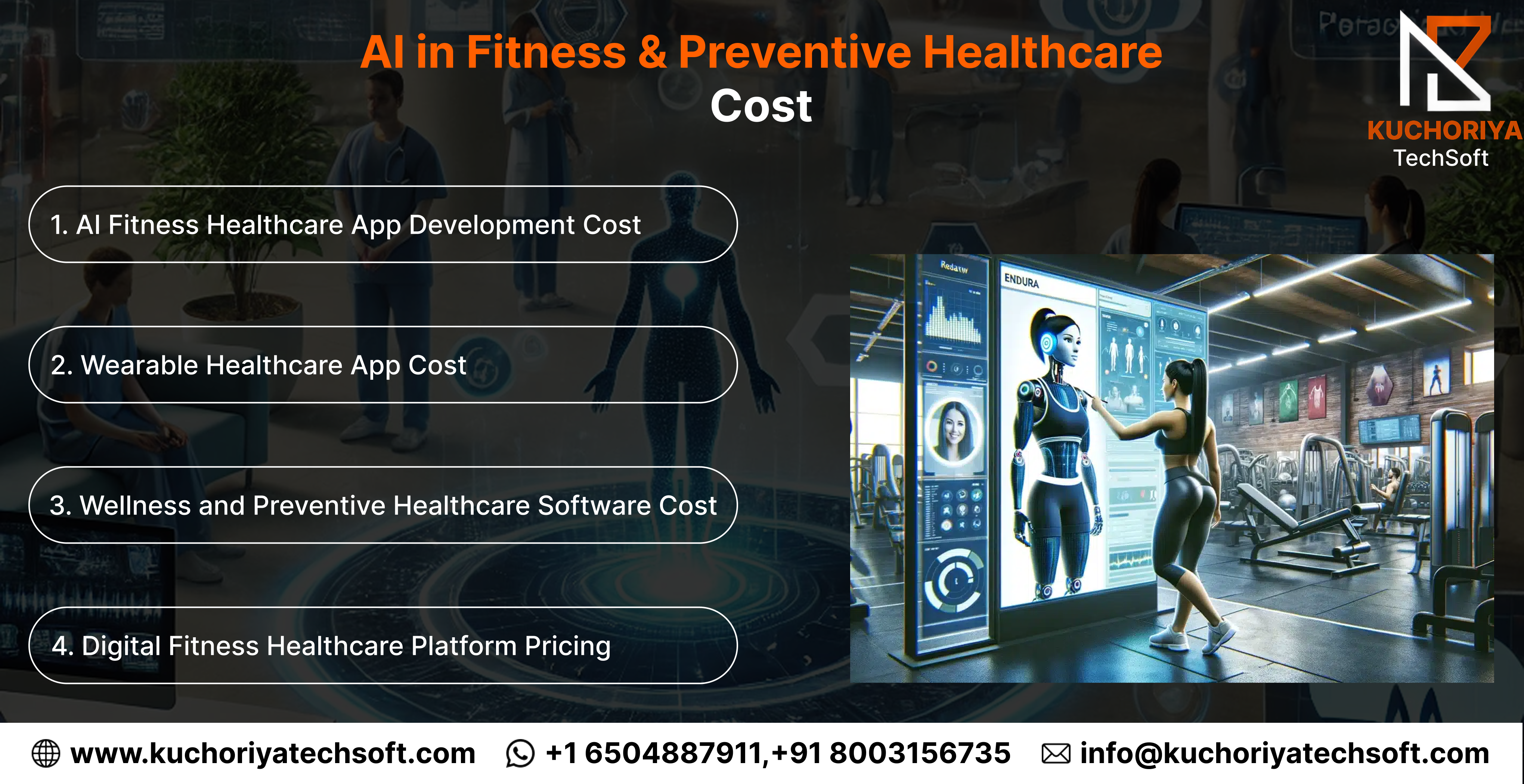
AI-powered fitness and preventive healthcare platforms help reduce long-term medical expenses while improving user engagement. Businesses planning such solutions must balance AI intelligence, wearable integrations, and scalability—often guided by experienced healthcare technology teams like Kuchoriya TechSoft.
1. AI Fitness Healthcare App Development Cost
AI-driven fitness apps deliver personalized workouts and health insights. The fitness healthcare app development cost and AI fitness healthcare solution pricing depend on AI models, real-time analytics, and personalization depth.
2. Wearable Healthcare App Cost
Modern fitness platforms integrate smartwatches and IoT devices for continuous tracking. The wearable healthcare app cost increases with advanced sensor data processing and secure device synchronization.
3. Wellness and Preventive Healthcare Software Cost
Preventive platforms use AI to identify health risks early. The wellness and preventive healthcare software cost varies based on predictive analytics, behavioral tracking, and long-term data modeling.
4. Digital Fitness Healthcare Platform Pricing
Scalable fitness ecosystems require robust backend architecture. Digital fitness healthcare platform pricing depends on user volume, performance optimization, and multi-user management features.
Blockchain in Healthcare and Data Security Cost
Blockchain is transforming healthcare by enabling tamper-proof medical records, secure data sharing, and decentralized platforms. Organizations adopting blockchain as part of healthcare digital transformation cost planning must account for security, compliance, and system scalability—often supported by experienced technology partners like Kuchoriya TechSoft.
1. Blockchain Healthcare Development Cost
Implementing blockchain in healthcare involves blockchain healthcare development cost and healthcare blockchain solution pricing, depending on network type, smart contracts, and data volume handled across hospitals and providers.
2. Secure Medical Records and Decentralized Platforms
Blockchain ensures immutable patient records and transparent access control. Costs include secure medical records blockchain cost and decentralized healthcare data platform pricing, driven by storage architecture and node management.
3. Blockchain Compliance and Regulatory Security
Healthcare blockchains must meet strict legal standards. This adds blockchain healthcare compliance cost and healthcare data security cost to ensure encryption, audit trails, and regulatory alignment.
4. AI + Blockchain Integrated Healthcare Systems
Advanced platforms combine AI analytics with blockchain security. Such systems involve AI blockchain healthcare cost, blockchain-based AI healthcare system cost, and AI-powered secure healthcare data platform pricing for end-to-end intelligence and trust.

AI Healthcare Cost vs ROI Analysis
Understanding the balance between investment and returns is critical before adopting AI in healthcare. Leaders assess AI healthcare investment cost against long-term efficiency, patient outcomes, and operational savings—often with guidance from experienced partners like Kuchoriya TechSoft.
1. Infrastructure and Scalability Investment
AI adoption requires spending on AI healthcare infrastructure cost, AI healthcare cloud hosting cost, and AI healthcare scalability cost to support data growth and real-time performance.
2. Maintenance and Long-Term Ownership
Post-deployment expenses include AI healthcare maintenance and support cost and AI healthcare total cost of ownership, which directly affect sustainability and budget forecasting.
3. ROI Through Automation and Clinical Optimization
AI improves diagnostics, reduces administrative workload, and accelerates patient care delivery. These gains contribute to strong AI healthcare ROI through cost savings and improved clinical outcomes.
4. Strategic Cost Planning for Executives
Effective ROI depends on AI healthcare cost estimation, AI deployment cost planning, and leadership-driven initiatives such as the CTO guide to AI healthcare cost and CTO AI healthcare budgeting.
AI Healthcare Cost vs ROI Comparison Table
How to Reduce AI Healthcare Implementation Cost
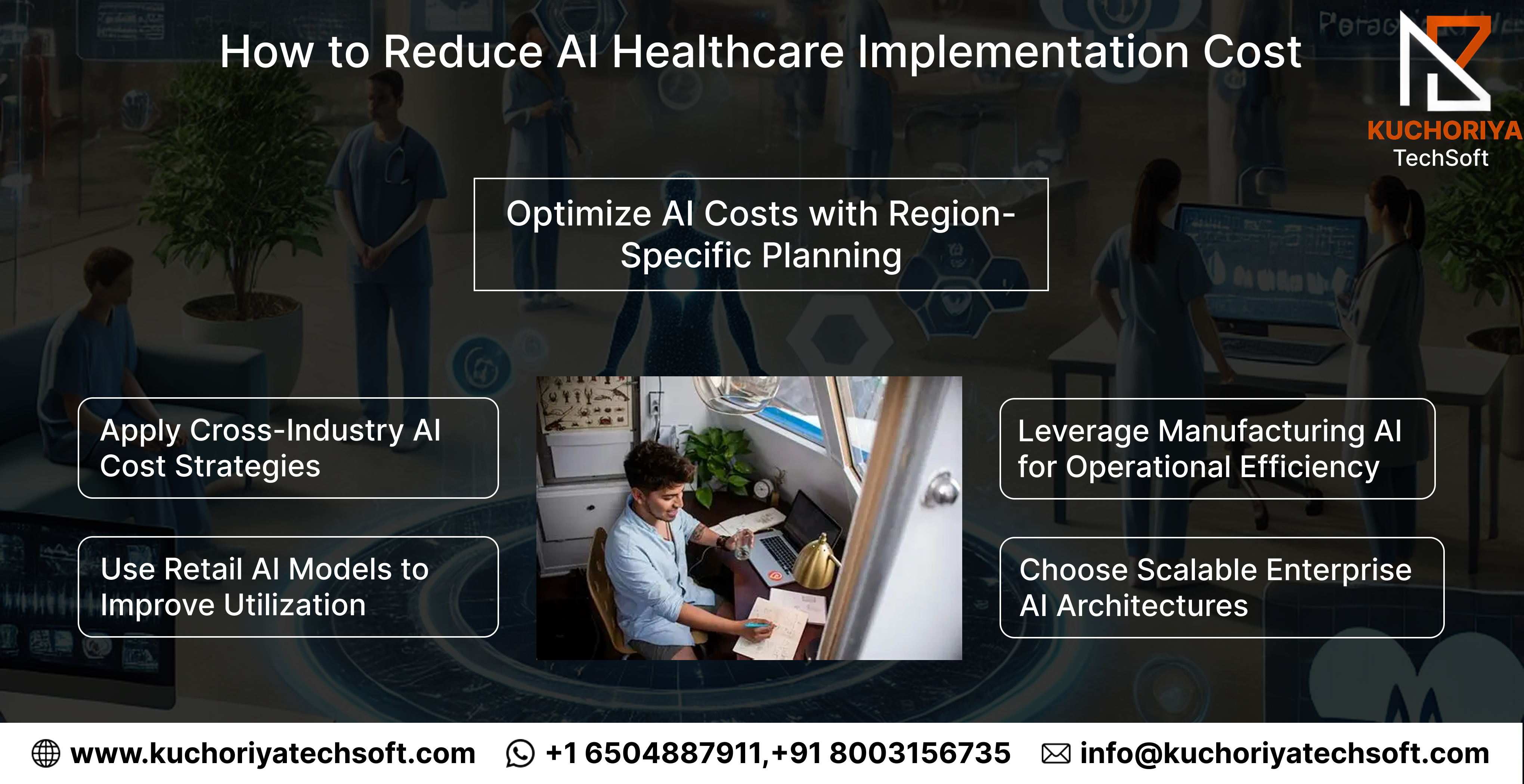
Reducing AI expenses requires smart planning across regions, industries, and technology stacks. Healthcare organizations evaluating the cost of implementing AI in healthcare can significantly optimize budgets by following proven global and cross-industry strategies, often executed by experienced teams like Kuchoriya TechSoft.
1. Optimize AI Costs with Region-Specific Planning
AI pricing varies by geography. Understanding AI healthcare development cost USA, AI healthcare pricing UK, AI healthcare implementation cost Europe, AI healthcare software cost Middle East, and AI healthcare platform pricing Australia helps organizations choose the most cost-effective deployment model.
2. Apply Cross-Industry AI Cost Strategies
Lessons from other industries reduce healthcare AI spend. Proven insights from AI in finance cost, fintech AI software development pricing, AI fraud detection platform cost, and AI risk management system pricing help optimize data security and automation budgets.
3. Leverage Manufacturing AI for Operational Efficiency
Healthcare systems can reduce costs by adopting models inspired by AI in manufacturing cost, industrial AI platform pricing, and AI predictive maintenance system cost to optimize infrastructure and equipment usage.
4. Use Retail AI Models to Improve Utilization
Techniques from AI in retail cost, AI recommendation engine pricing, and AI inventory optimization platform cost help hospitals optimize resource allocation and reduce operational waste.
5. Choose Scalable Enterprise AI Architectures
Selecting scalable platforms lowers long-term spend. Leveraging enterprise AI software development cost, custom AI solution pricing, AI product development pricing, and AI system integration cost ensures flexibility without overengineering.
Why Choose Kuchoriya TechSoft for AI Healthcare Solutions
Choosing the right technology partner is critical when evaluating AI healthcare implementation cost and long-term scalability. Kuchoriya TechSoft helps healthcare organizations build cost-efficient, secure, and future-ready AI solutions with a clear focus on ROI.
1. Proven Expertise in AI Healthcare Development
We specialize in optimizing AI healthcare development cost through scalable architectures, compliance-ready systems, and performance-driven AI models tailored for real-world healthcare needs.
2. End-to-End Cost Transparency
Our approach provides clear visibility into AI healthcare pricing, ensuring predictable budgeting across development, deployment, and ongoing optimization.
3. Secure, Compliant, and Scalable Solutions
From data protection to system reliability, we design platforms that balance healthcare software cost with long-term performance and regulatory alignment.
4. Cross-Industry AI Intelligence Advantage
Our experience across healthcare, finance, retail, and manufacturing allows us to apply proven cost-optimization strategies that reduce implementation risks and improve outcomes.
5. ROI-Focused AI Implementation Strategy
Every solution is aligned with measurable business goals, ensuring AI investments deliver sustainable value beyond initial deployment.
Conclusion: Is AI in Healthcare Worth the Cost in 2026?
In 2026, evaluating the AI in healthcare cost is a strategic decision for hospitals, startups, and enterprises planning long-term growth. From managing the AI healthcare implementation cost to optimizing the AI healthcare total cost of ownership, success depends on informed planning and the right execution approach.
Organizations that align AI initiatives with measurable outcomes consistently achieve higher AI healthcare ROI, improved clinical efficiency, and scalable digital healthcare platforms. Strategic AI healthcare cost estimation and structured deployment reduce financial risks while accelerating innovation.
If you are planning to invest in AI-driven healthcare solutions, now is the right time to Contact Us for expert guidance, cost planning, and implementation support. Businesses and consultants can also join our Referral Partner Program to collaborate on delivering scalable, compliant, and ROI-focused AI healthcare solutions in global markets.
FAQs on AI in Healthcare Cost
Q. What factors influence AI healthcare pricing the most?
A. Key factors include AI healthcare pricing, data volume, compliance requirements, infrastructure complexity, and long-term scalability needs.
Q. How do enterprises plan AI healthcare budgets effectively?
A. Enterprises rely on CTO guide to AI healthcare cost, structured CTO AI healthcare budgeting, and phased investment models to control risks and spending.
Q. Is AI healthcare investment cost justified for large hospitals?
A. Yes, when aligned with outcomes. Proper AI pricing vs ROI analysis shows long-term savings through automation and efficiency gains.
Q. How does AI deployment cost planning reduce risks?
A. Early AI deployment cost planning helps avoid overengineering and supports smarter infrastructure and compliance decisions.
Q. What role does architecture play in AI healthcare cost control?
A. Efficient system design lowers AI healthcare architecture planning cost and supports future scalability without repeated redevelopment.
Q. How should executives align AI with enterprise technology goals?
A. By mapping AI initiatives to the enterprise healthcare technology roadmap cost and following a clear CTO AI investment strategy.